Even though the practice of metadata were changed from catalogue cards to machine-readable formats, for a long time metadata information is stored in repositories as electronic records. During the recent year, the World Wide Web is moving from the web of documents to the web of data. The metadata information is moving from merely machine-readable towards machine-processable, where it is essential to break the record and repository silos and make data (especially metadata) into machine understandable pieces. We present information about the data using the RDF (Resource Description Framework) which provides a data model for presenting metadata as machine-understandable and –processable triple statements (i.e., subject, object, predicate). For example, Adam (subject) is from (predicate) Peru(object). The subject of a triple is the URI (Uniform Resource Identifier) identifying the described resource, a predicate is the existing relationship between subject and object, and an object is a literal value or the URI of resources that is somehow related to the subject. In the above example, “Adam” is a person and “Peru” is a country. Although they represent totally different metadata, they are linked through the predicate (properties) and made it possible to gain the data and information from Adam to Peru such as the population, environment, currency, culture etc. of Peru. Furthermore, the information will be connected into the Linked Open Data (LOD) cloud where anybody can join, put their data and access the others information. This can be used by UN organizations, and play the role of one family for providing the services to the world. The linked data will have an impact on e-science, e-government, and e-agriculture.
Friday, January 7, 2011
The role of Information manager and Information flows at the moment

The year 2011 is a personalization of Web
Friday, November 5, 2010
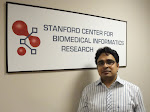
my visit to Stanford University
It was my dream to go to Stanford University. As I always try to follow my supervisor footstep. I started to my journey on 13th of October behind my beloved Nargish at Rome. It was terrible moment in my life to say goodbye to her. I had to do it because I wanted to explore my experience.
I arrived the special Terminal 5, a special terminal for USA flight. Very tight security. After crossing the security, I got into the plan and landed at Philadelphia International Airport. The immigrant officer asked me several question at least 45 min and gave me a seal to my passport to enter the USA. Again flight to San Francisco L. At last I arrived to Stanford Gust house. The Guest house was very nice.
On 14th , I got up from my bed very early and took my breakfast. I came to know that there was very nice shuttle service for Stanford Campus. I got into the Shuttle and got down in front of the Lab. The Lab Secretary gave me the schedule of meeting with Professor and researchers. Meanwhile, I met two visiting fellow from Germany, Austria. First day, I had a wonderful time with them.
Later on, I met with Professor Mark Musen. He was so kind human being and explained me lots of their work. I also showed my work. He appreciated the work. I also met with Natasha Noy (a key person of Protégé tool, bio-medical ontology). She showed me the work of ICAT, a web-based frame work for protégé tool. They have developed this frame work for WHO. I wonder to see their work. It is similar work that we have done. But, our work has been started at FAO since 2005. It shows the importance of our work. It was also wonderful to work and chat with Timothy Redmond.
I got a little change to visit the campus beside my work. It was amazing environment. I wish I could study in here J. Now, I understood why they are different from others. It is a place for study.
Thursday, July 22, 2010
cooking and spending time
Tuesday, July 13, 2010
Agrovoc OWL to SKOS
http://www.comp.glam.ac.uk/pages/research/hypermedia/nkos/nkos2010/
I am extremely happy.. Now, I am preparing for USA on-line teaching at University...
Keep my finger cross for visa... !!
Monday, June 28, 2010
DC2010 paper
Wednesday, June 16, 2010
URI VS URL
URI:
A URI identifies a resource either by location, or a name, or both. More often than not, most of us use URIs that defines a location to a resource. The fact that a URI can identify a resources by both name and location has lead to a lot of the confusion in my opionion. A URI has two specializations known as URL and URN.
URN
A URI identifies a resource by name in a given namespace but not define how the resource maybe obtained. This type of URI is called a URN. You may see URNs used in XML Schema documents to define a namespace, usually using a syntax such as:
URL
A URL is a specialization of URI that defines the network location of a specific resource. Unlike a URN, the URL defines how the resource can be obtained. We use URLs every day in the form of http://damnhandy.com, etc. But a URL doesn’t have to be an HTTP URL, it can be ftp://damnhandy.com, smb://damnhandy.com, etc.
In the last word, we can say that URI is identifier of resource and URL gives us information to obtaine this resource.
if URL present our homepage then each object can be retrieved from the homepage by using the URI ( ex. URL and URI of Ahsan (www.ahsanmorshed.bloger.com and ://ahsanmorshed.blogger/ahsanmorshed )